A principios de la década de 1980, se descubrió que la Sociedad Watchtower (el brazo propagandístico de los Testigos de Jehová) había insertado imágenes subliminales de caracter satánico en los dibujos e ilustraciones de sus publicaciones. (In the early 1980s, it was discovered that the Watchtower Society (the propaganda arm of the Jehovah’s Witnesses) had inserted subliminal satanic images into the drawings and illustrations of its publications.)
Esta práctica no cesó tras ese descubrimiento, sino que ha continuado hasta el día de hoy. (This practice did not stop after that discovery but has continued to this day.)
La Watchtower ha estado insertando subrepticiamente mitades de rostros de demonios, y de formas psicodélicas sugestivas de locura y maldad, en las ilustraciones de sus libros y revistas durante más de cuatro décadas. Esto no es una teoría conspirativa; es un hecho, y quien lo niegue simplemente ignora la evidencia. (The Watch Tower has surreptitiously inserted halves of demon faces into their artwork for more than four decades. This is not a conspiracy theory; it is a fact, and anyone who denies it is simply blind to the evidence.)
El tipo específico de imágenes subliminales que los máximos líderes de los Testigos de Jehová han insertado en sus ilustraciones son mitades de rostros de demonios y formas psicodélicas sugestivas de locura y maldad. (The specific type of subliminal images that the top leaders of Jehovah’s Witnesses have inserted into their illustrations are halves of demonic faces and psychedelic shapes suggestive of madness and evil.)
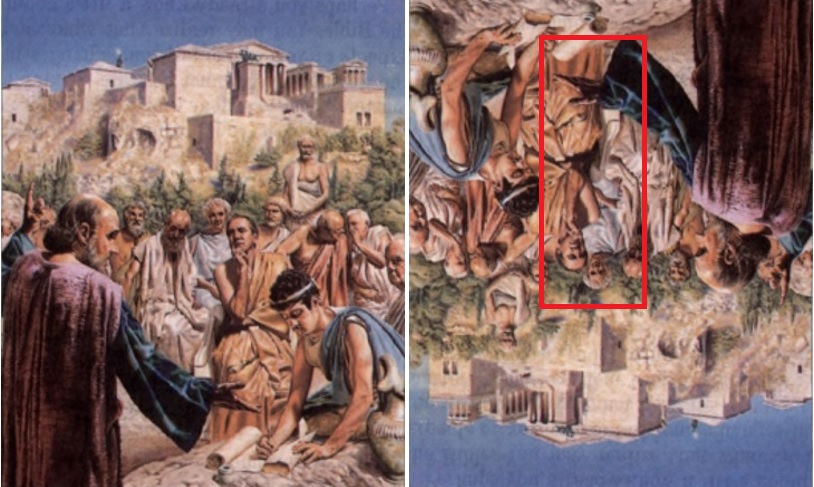
Para descubrir estas imágenes ocultas, debe tomar algunas piezas de arte de los Testigos de Jehová, tal como aparecen impresas en sus publicaciones y colocar un espejo en un lugar específico dentro de cada pintura, creando una nueva imagen compuesta por la mitad de cada obra vista hacia adelante y hacia atrás al mismo tiempo; una especie de equivalente visual del enmascaramiento inverso en audio. (Suena complicado, pero en realidad no es más que la antigua técnica del espejo de feria aplicada a una obra de arte estática). Y al verlas de esta manera, las nuevas imágenes que se forman contienen imágenes compuestas que se asemejan a cabezas de demonios, rostros torturados, y formas psicodélicas sugestivas de locura y maldad. (To uncover these hidden images you have to take some JW art as printed in the Jehovah’s Witnesses publications and place a mirror at a specific place within each piece of art, creating a new image composed of one-half of each piece viewed forward and backward at the same time — sort of the visual equivalent of backwards masking in audio. (It sounds complicated, but it’s really nothing more than the old funhouse mirror technique applied to a piece of static art.) And when viewed in this way, the new images formed really contain composite images that resemble devil’s heads, moaning, tortured faces, and psychedelic shapes suggestive of madness and evil.)
Veamos algunos ejemplos (Let´s see some examples):
Página 35 del libro "el CONOCIMIENTO Que Lleva a la Vida Eterna" (Page 35 of the book “The Knowledge That Leads to Everlasting Life”):


Página 5 del libro “¿Qué Enseña Realmente la Biblia?”. Esta pieza de arte también se encuentra en el siguiente sitio web de los Testigos de Jehová (Page 5 of the book “What Does The Bible Really Teach?”. This piece of art is also in the following Jehovah’s Witnesses website:
Historia 9, página 25, de "My Book of Bible Stories" (“Mi libro de historias bíblicas” versión en inglés) - edición 1978 (Page 25, story 9, of “My Book of Bible Stories” - 1978 edition):


Página 190 del libro “¿Qué Enseña Realmente la Biblia?”, y en el siguiente sitio web de los Testigos de Jehová (Page 190 of the book “What Does the Bible Really Teach?”, and in the following Jehovah’s Witnesses website): https://www.jw.org/en/library/books/bible-teach/love-god-with-your-whole-heart/
Página 68 del libro “Apocalipsis… ¡se acerca su magnífica culminación!” (Page 68 of the book "Revelation—Its Grand Climax At Hand!"):
Página 35 del libro "El CONOCIMIENTO que lleva a la vida eterna" (Page 35 of the book “The KNOWLEDGE that leads to eternal life”):
Esta figura representa a un demonio llamado Cthuluh. (This figure represents a demon called Cthulhu.)
Página 9 del libro “¿Qué Enseña Realmente la Biblia?” (Page 9 of the book “What Does the Bible Really Teach?”): 

Página 11 de la revista La Atalaya, número 1, 2025: (Page 11 of The Watchtower magazine, number 1, 2025):
Cubierta de la revista La Atalaya, de enero de 2025 (Edición de Estudio) Cover of the January 2025 issue of The Watchtower (Study Edition):
Página 158 del libro “¿Qué Enseña Realmente la Biblia?” (Page 158 of the book “What Does The Bible Really Teach?”)
ANTECEDENTES (BACKGROUND HISTORY)
A comienzos de los años 80, un artista anónimo de la Watchtower reveló que los principales artistas de la Watchtower habían comenzado a insertar dibujos de demonios en las ilustraciones de sus libros. Ellos habían hecho esto por orden del Cuerpo Gobernante de los Testigos de Jehová. (In the early 1980s, an anonymous Watchtower artist revealed that the Watchtower artists had inserted drawings of demons into the illustrations of their books. They had inserted these demonic faces by order of the Government Body.)
Según el artista, la mayoría de las ilustraciones en las publicaciones de los Testigos de Jehová contenían mitades de rostros demoníacos y formas psicodélicas que sugerían locura y maldad. Estos rostros eran una especie de «vigilantes» y representaban la omnipresencia de Satanás; los «ojos y oídos» del diablo. Estos rostros podían ser descubiertos usando un espejo. (According to the artist, most of JW pieces of art contains halves of demon faces and psychedelic shapes suggestive of madness and evil. These faces were kind of “watchers” and represented the omnipresence of Satan; the “eyes and ears” of the devil. These faces could be exposed using a mirror.)
Además, estas imágenes también constituyen un signo de propiedad o pertenencia (similar a lo que hacen los lobos cuando marcan su territorio con su orín). Furthermore, these images also constitute a sign of ownership or belonging (similar to what wolves do when they mark their territory with their urine).
La primera imagen de este tipo publicada por el artista anónimo de la Watchtower se encontraba en la página 20 del libro «La felicidad: cómo hallarla» (1980). (The first image of this kind published by the anonymous Watchtower artist was found on page 20 of the book "Happiness: How to Find It" (1980):
La segunda imagen reflejada, expuesta por el artista de la Watchtower, se encontraba en la página 10, historia 1, de “Mi Libro de Historias Bíblicas” – edición de 1978 (solo en la versión en inglés). Esta obra de arte también aparece en el siguiente sitio web de los Testigos de Jehová: (The second reflected image, exposed by the Watchtower artist, was on page 10, story 1, of “My Book of Bible Stories” – 1978 edition (only in the English version). This piece of art is also in the following Jehovah’s Witnesses’ website):
Se trata de un djinn (también escrito jinn o yinn), un espíritu maligno de la mitología árabe y la religión islámica. (This is a djinn (also spelled jinn or yinn), an evil spirit from Arabic mythology and Islamic religion.)
De hecho el libro “My Book of Bible Stories”, edición 1978 (al que conocemos en español como “Mi Libro de Historias Bíblicas”) fue el texto pilóto en el que se insertaron por primera vez mitades de rostros de demonios. Esto sólo se hizo en la versión en inglés. Las versiones de este libro en otros idiomas no contenían mitades de rostros de demonios; las ilustraciones habían sido alteradas. In fact, the 1978 edition of "My Book of Bible Stories" (known in Spanish as "Mi Libro de Historias Bíblicas") was the pilot text in which halves of demon faces were first inserted. This was only done in the English version. Versions of this book in other languages did not contain halves of demon faces; the illustrations had been altered.
Por ejemplo, el diablo de la página 25, historia 9, de la edición de 1978 de «Mi Libro de Historias Bíblicas» sólo se puede obtener en la versión en inglés (“My Book of Bible Stories”) For example, the devil on page 25, story 9, of the 1978 edition of "My Book of Bible Stories" can only be obtained in the English version:
En las versiones en otros idiomas de My Book of Bible Stories, la ilustración aparece modificada. Veamos:
In other language versions of My Book of Bible Stories, the illustration appears modified. Let's see:
Página 25, historia 9, de la edición en inglés de «Mi Libro de Historias Bíblicas» (1978):
Page 25, story 9, of the English edition of "My Book of Bible Stories" (1978):
Compárese con la ilustración de la versión en español (“Mi Libro de Historias Bíblicas”), italiano (“Il Mio Libro di Storie Bibliche”), y portugués (Meu Livro de Histórias Bíblicas):
Compare the illustration as it appears in the Spanish version (“Mi Libro de Historias Bíblicas”), the Italian version (“Il Mio Libro di Storie Bibliche”), and the Portuguese version (Meu Livro de Histórias Bíblicas): A lo largo de varios meses el artista renegado de la Watchtower continuó exponiendo imagenes demoniacas ocultas en los libros de los testigos de Jehová. (For several months the Watchtower rogue artist continued to expose demonic images hidden in the JW publications.)
Página 87, historia 38 de “Mi Libro de Historias Bíblicas”, edición 1978, edición en inglés (Story 38, page 87, of the book “My Book of Bible Stories”, issue 1978):
Página 38, historia 14 de “Mi Libro de Historias Bíblicas”, edición 1978, en inglés (Story 14, page 38, of the book “My Book of Bible Stories”, issue 1978):


Página 8, historia 24 de “Mi Libro de Historias Bíblicas”, edición 1978, en inglés Story 8, page 24, of the book “My Book of Bible Stories”, issue 1978:

Para aquellos que recibieron estos dibujos del artista renegado de la Watchtower era claro que esto no podía ser producto del azar. Es lógico que pueda encontrarse algún rostro "demoníaco" usando un espejo en un parque, en un bosque, en el jardín de una casa, pero no en una pieza de arte de 10 x 10 cms. For those who received these drawings from the Watchtower's renegade artist, it was clear that this could not be a coincidence. It's understandable that one might find a "demonic" face using a mirror in a park, a forest, or a garden, but not in a 4" x 4" piece of art.
Se producen entonces dos acontecimientos importantes. Primero, la desaparición del artista informante de la Watchtower (aquel que había dado a conocer estas imágenes subliminales). Nunca más se volvió a saber de él. Jamás nadie volvió a recibir de él una carta con dibujos y explicaciones sobre estas imágenes. Segundo, la publicación de un artículo en la revista La Atalaya del 1 de septiembre de 1984, en el que la JW.ORG negaba la existencia de estas imágenes, y trataba todo el asunto como un rumor sin fundamento. Two important events then occurred. First, the Watchtower artist (the one who had revealed these subliminal images) disappeared. He was never heard from again. No one ever received another letter from him with drawings and explanations about these images. Second, an article was published in the September 1, 1984, issue of The Watchtower magazine, in which JW.ORG denied the existence of these images and treated the whole matter as an unfounded rumor.
Sin embargo, los rostros demoniacos siguieron insertándose en las ilustraciones de la JW.ORG. However, demonic faces continued to be inserted into the JW illustrations.
A continuación, examinaremos algunos de estos rostros demoníacos y su relación con la brujería y el satanismo (Next, we will examine some of these demonic faces and their relationship to witchcraft and Satanism):
Página 27 de la revista “La Atalaya” del 15 de agosto de 1993 (Page 27 of “The Watchtower” magazine, issue August 15th, 1993):


Para revelar esta imagen oculta lo único que se ha hecho es tomar la pieza de arte, tal como se halla en la revista, y colocar un espejo en un lugar específico dentro de la misma, creando así una nueva imagen compuesta de la mitad de la pintura vista hacia adelante y hacia atrás al mismo tiempo (To reveal this hidden image, all that has been done is to take the piece of art, just as it appears in the magazine, and place a mirror in a specific spot within it, thus creating a new image composed of half of the painting seen both forwards and backwards at the same time).
La nueva imagen que se forma se asemeja a la cabeza de un demonio o diablo. Aparece también una especie de "espíritu familiar" flotando sobre la cabeza de este diablo, y un par de mujeres que observan, a manera de brujas, al demonio (The new image that is formed resembles the head of a demon or devil. There also appears a kind of 'familiar spirit' floating above the head of this devil, and a couple of women watching, like witches, the demon):
Esta escena nos trae a la memoria la pintura llamada El Aquelarre del pintor español Francisco de Goya (This scene brings to mind the painting called "El Aquelarre" (The Witches' Sabbath) by the Spanish painter Francisco de Goya):
Un Aquelarre era una reunión secreta de brujos que se realizaba a intervalos regulares durante las edades Media y Moderna. Estas reuniones se llevaban a cabo generalmente en los bosques, y se desarrollaban de una manera muy peculiar. El jefe de los brujos presidía dicha Reunión usualmente disfrazado de carnero o de macho cabrío (razón por la cual las pinturas sobre aquelarres, de Francisco de Goya, muestran a un carnero humanoide como personaje central). (An Aquelarre (a witches' Sabbath) was a secret gathering of witches that took place at regular intervals during the Middle Ages and the Modern Era. These meetings were usually held in forests and unfolded in a very peculiar way. The leader of the witches presided over the gathering, usually disguised as a ram or a billy goat (which is why the paintings of witches' sabbaths by Francisco de Goya depict a humanoid ram as the central figure).
Página 35 del libro "El CONOCIMIENTO que lleva a la vida eterna" (Page 35 of the book “The KNOWLEDGE that leads to eternal life”):
Esta figura representa a un demonio llamado Cthuluh. Cthulu es un demonio cósmico creado por el escritor H. P. Lovecraft y presentado por primera vez en el cuento "The Call of Cthulhu", publicado en la revista estadounidense Weird Tales (Cuentos Extraños) en 1928. (This figure represents a demon called Cthulhu. Cthulhu is a cosmic demon created by the writer H. P. Lovecraft and first introduced in the short story "The Call of Cthulhu," published in the American magazine Weird Tales in 1928.)
La cabeza de Cthulhu se describe como semejante a la de un pulpo gigante, con un número desconocido de tentáculos que rodean su supuesta boca. Comparemos ahora una representación común de la cara de Cthulhu con la imagen reflejada (mirroring image) que encontramos en la página 35 del libro "El conocimiento que lleva a la vida eterna" (Cthulhu's head is described as resembling that of a giant octopus, with an unknown number of tentacles surrounding its supposed mouth. Let us now compare a common depiction of Cthulhu's face with the mirrored image found on page 35 of the book "The Knowledge That Leads to Eternal Life."):
H. P. Lovecraft, fue un escritor estadounidense, autor de novelas y relatos de terror. Su obra constituye un clásico del horror cósmico. (H. P. Lovecraft was an American writer, author of horror novels and short stories. His work is considered a classic of cosmic horror.)
Page 5 of the book “What Does The Bible Really Teach?” (Página 5 del libro “¿Qué Enseña Realmente la Biblia?”):
Lo que tenemos aquí es un “Espíritu Familiar” semejante en aspecto al reptil australiano Chlamydosaurus Kingii (What we have here is a “Familiar Spirit” similar in appearance to the Australian reptile Chlamydosaurus Kingii):
Es interesante notar que el arco superciliar del personaje, en la imagen revelada, es mucho más pronunciado que en el reptil real. En ese sentido, la versión prehistórica del Chlamydosaurus Kingii se asemeja más a la imagen descubierta, veamos (It's interesting to note that the brow ridge of the figure in the revealed image is much more pronounced than on the actual reptile. In that sense, the prehistoric version of Chlamydosaurus kingii more closely resembles the discovered mirroring image. Let's take a look):
Ahora bien, la imagen reflejada es más humanoide; es decir, el rostro es más plano, la mirada más humana. En otras palabras, y tal como dijimos al comienzo, lo que tenemos aquí es un “Espíritu Familiar” (However, the mirroring image is more humanoid; that is, the face is flatter, the gaze more human. In other words, and as we said at the beginning, what we have here is a “Familiar Spirit”).
Un espíritu familiar es un ente espiritual con poderes mágicos que, según la tradición europea, particularmente británica, irlandesa, francesa y griega, sería invocado por un mago o un brujo. Normalmente adoptan la forma de animales domésticos o de criaturas mitológicas o demoníacas. La siguiente es una ilustración extraída del libro Daemonologia: a discourse on witchcraft escrito por Edward Fairfax en 1621. Aquí aparecen a los diferentes tipos de espíritus familiares que suelen acompañar a los brujos (A familiar spiritis a spiritual entity with magical powers that, according to European tradition, particularly British, Irish, French and Greek, would be invoked by a magician or witch. They usually take the form of domestic animals or mythological or demonic creatures. The following is an illustration taken from the book Daemonologia: a discourse on witchcraft written by Edward Fairfax in 1621. Here you are the different types of familiar spirits that usually accompany witches and warlocks):
Tal como explicara Emma Wilby, los espíritus familiares “…podían manifestarse en numerosas formas, generalmente como un animal, pero a veces como una figura humana o humanoide, y fueron descritos como "formas tridimensionales, claramente definidas, vívidas con color y animadas con movimiento y sonido", a diferencia de las descripciones de fantasmas con sus "formas ahumadas e indefinidas" (Véase la página 61 de la obra Cunning Folk and Familiar Spirits: Shamanistic Visionary Traditions in Early Modern British Witchcraft and Magic, por Emma Wilby // Véase también la obra El Culto de la Brujería en la Europa Occidental, capítulo VIII: Familiares y Transformaciones, el Familiar Doméstico, escrito por la antropóloga británica Margaret Murray) As Emma Wilby explained, familiar spirits “…could manifest as numerous forms, usually as an animal, but sometimes as a human or humanoid figure, and were described as "clearly defined, three-dimensional... forms, vivid with colour and animated with movement and sound", as opposed to descriptions of ghosts with their "smoky, undefined form[s]" (Cunning Folk and Familiar Spirits: Shamanistic Visionary Traditions in Early Modern British Witchcraft and Magic, page 61, by Emma Wilby // See also The witch-cult in western Europe, chapter VIII: The Familiars and Transformation, The Domestic Familiar, by Margaret Murray)
Compare esta imagen reflejada con la cabeza de Alien (Alien el Octavo Pasajero) y con la cabeza de Pui Pui de Dragon Ball Z (Compare this mirroring image with the Alien’s head (Alien: the Eighth Passenger), and with the Pui Pui’s head (Dragon Ball Z):
La imagen resultante es, básicamente, un retrato estilizado del xenomorfo Alien. (The resulting image is, basically, a stylized portrait of the Alien xenomorph.)
¿Sabía usted que la criatura de la saga Alien estaba basada en un personaje del libro NECRONOMICON de H. R. Giger? (Did you know that the creature in the Alien saga was based on a character from the book NECRONOMICON by H. R. Giger?)
Página 189 del libro “El CONOCIMIENTO que lleva a la vida eterna” (Page 180 of the book “The Knowledge That Leads to Everlasting Life”):


Como habrán podido notar, el tema de las imágenes subliminales en las publicaciones de los Testigos de Jehová es bastante complejo. Por ejemplo, cuando aquellos que fueron jóvenes en los años 90 observan la imagen reflejada que acabamos de mostrar (página 189 del libro “El CONOCIMIENTO que lleva a la vida eterna”, y cubierta de la revista “La Atalaya”, del 15 de noviembre de 1995) lo primero que se les viene a la mente es un personaje del anime Dragon Ball; Piccolo Daimaku. (As you can see, the subject of hidden subliminal images in Jehovah’s Witnesses’ publications is very complex. For example, when a young person looks at the mirroring image on the cover of the magazine “The Watchtower”, issue November 15, 1995 (and on page 180 of the book “The Knowledge That Leads to Everlasting Life”), the first thing that comes to his/her mind is a character from the anime Dragon Ball; Piccolo Daimao or Evil King Piccolo):
Comparemos este rostro especular con Piccolo Daimaku (el Rey Demonio) y uno de sus hijos (Let's compare this mirroring image with Piccolo Daimaku (the Demon King) and one of his sons):
De hecho, hay muchos puntos en común entre estas figuras: las antenas, los colmillos los ojos y las orejas puntiagudas (In fact, there are many points in common between these figures: the antennae, the fangs, the eyes, and the pointed ears).
Algunos fanáticos del anime podrían encontrar aún más puntos en común entre estas dos imágenes. Preste atención a la baba que corre por la boca de Piccolo Daimaku y compárela con la baba que cae de la boca de la imagen que estamos examinando (Some anime fans might find even more similarities between these two images. Pay attention to the drool running from Piccolo Daimaku's mouth and compare it to the drool dripping from the mouth in the image we're examining):
La baba corre por la boca de Piccolo Daimaku porque él procrea hijos por medio de huevos que expulsa por la boca. (The saliva runs from Piccolo Daimaku's mouth because he procreates children by means of eggs that he expels from his mouth.)
Aquí la pregunta surge por sí sola; ¿Por qué hay tantos puntos en común entre estas dos figuras? La verdad es que ambos se inspiraron en un personaje de la película “El Exorcista II” (1973). Casi al comienzo de esta película se ve como el joven Kokumo es poseído por un demonio llamado Pazuzo. El hombre que se ve en la foto, disfrazado de langosta, es Kokumo ya convertido en adulto. Este disfraz lo identifica como el brujo principal, el médico brujo, el dios encarnado. Kokumo pueden escupir huevos por la boca. De hecho, él dice: “Si Pazuzu viene por ti, escupiré un leopardo”. (The question arises naturally: Why are there so many similarities between these two figures? The truth is, they were both inspired by the same character: a character from the film "The Exorcist II" (1973). Near the beginning of the film, we see the young Kokumo possessed by a demon named Pazuzu. The man in the photo, disguised as a lobster, is Kokumo as an adult. This disguise identifies him as the main sorcerer, the witch doctor, the god incarnate. Kokumo can spit eggs. In fact, he says, "If Pazuzu comes for you, I'll spit out a leopard."):

El “leopardo” (demonio), que este personaje escupe por la boca, también se puede encontrar en la imagen reflejada que acabamos de revelar. ¿Ve usted el rostro felino que aparece debajo de la boca de la imagen especular? (The “leopard” (demon) that this character spits out can also be found in the mirrored image we just revealed. Do you see the feline face that appears below the mouth in the mirrored image?)

Página 120 del libro “Apocalipsis… ¡se acerca su magnífica culminación!” (Page 120 of the book "Revelation—Its Grand Climax At Hand!"):
Aunque en esta pieza de arte se hallan ocultos varios monstruos, destaca entre ellos el escuerzo monstruoso que abarca toda la pieza de arte. Comparemos este escuerzo monstruoso con el Pokémon anfibio Venusaur (Although several monsters are hidden within this artwork, the most prominent is the monstrous toad that covers the entire piece. We compare this monstrous toad to the amphibious Pokémon Venusaur):
Ahora comparemos la imagen reflejada con un escuerzo real. El escuerzo era uno de los animales más utilizados en la brujería medieval como "Espíritu Familiar" (Now let's compare the mirror image with a real toad. The toad was one of the animals most commonly used in medieval witchcraft as a "Familiar Spirit"):
La siguiente imagen se encuentra en el capítulo 1 del libro "El Conocimiento que Lleva a la Vida Eterna", de hecho, es la primera imagen que aparece en ese libro (The following image is found in Chapter 1 of the book "The Knowledge That Leads to Everlasting Life"; in fact, it is the first image that appears in that book):


Durante la Edad Media a los demonios se los representaba con características físicas grotescas. Estas características también fueron asignadas a los que se creía estaban al servicio de Satanás y sus demonios, es decir, los Judíos. Las imágenes que representaban a los judíos como monstruos o físicamente grotescos se hicieron cada vez más comunes. Un buen ejemplo de este tipo de monstruos lo podemos ver en Watto (personaje de Star Wars) (During the Middle Ages, demons were depicted with grotesque physical characteristics. These characteristics were also attributed to those believed to be in the service of Satan and his demons—that is, the Jews. Images depicting Jews as monsters or physically grotesque became increasingly common. A good example of this type of monster can be seen in Watto (a character from Star Wars):
¿QUÉ ES ESTO?
Es un culto satánico encriptado que mezcla elementos de la brujería medieval y la magia Enoquiana.
WHAT IS THIS?
It's an encrypted satanic cult that blends elements of medieval witchcraft and Enochian magic.
Estos rostros son una especie de «vigilantes» y representan la omnipresencia de Satanás; los «ojos y oídos» del diablo. Estos rostros pueden ser descubiertos usando un espejo. (These faces are kind of “watchers” and represent the omnipresence of Satan; the “eyes and ears” of the devil. These faces can be exposed using a mirror.)
Además, estas imágenes también constituyen un signo de propiedad o pertenencia (similar a lo que hacen los lobos cuando marcan su territorio con su orín). Furthermore, these images also constitute a sign of ownership or belonging (similar to what wolves do when they mark their territory with their urine).
Veamos más ejemplos (Let´s see more examples):
Página 44 del libro “¿Qué Enseña Realmente La Biblia?” (Page 44 of the book “What Does the Bible Really Teach?”: 
Cubierta de la revista La Atalaya, 2016, número 6 (Cover of The Watchtower magazine, Nº 6, 2016):
Página 69 del libro “¿Qué Enseña Realmente la Biblia?” (Page 69 of the book “What Does The Bible Really Teach?”):
Página 66, historia 28 de “Mi Libro de Historias Bíblicas”, edición 1978, sólo en la versión en inglés (Page 66, story 28 of the book “My Book of Bible Stories” (issue 1978):

Sólo la versión en inglés de 1978 de "My Book of Bible Stories” (“Mi Libro de Historias Bíblicas”) contenía mitades de rostros de demonios y figuras psicodélicas sugestivas de locura y maldad en más del 50% de sus ilustraciones. En las ediciones en otros idiomas de este libro, las imágenes se habían modificado. (Only the 1978 English version of "My Book of Bible Stories" alone contained demon halves and psychedelic figures suggestive of madness and evil in more than 50% of its illustrations. In editions of this book in other languages, the images have been altered.)
En 2004, la Watchtower publicó la nueva versión de "My Book of Bible Stories” (“Mi Libro de Historias Bíblicas”) con las ilustraciones que se habían usado en otros idiomas en 1978. Es decir, se eliminaron los rostros de demonios que se habían insertado en las piezas de arte de 1978. No quedaron "watchers" (vigilantes) en las ilustraciones salvo en la portada. Veamos (In 2004, the Watchtower published a new version of "My Book of Bible Stories" with the illustrations that had been used in other languages in 1978. That is, the demon faces that had been inserted into the 1978 artwork were removed. No "watchers" remained in the illustrations except on the cover. Let's see):
Este último "watcher" (vigilante) nos recuerda el primer árbol monstruo que se descubrió en los libros de la Watchtower. Este se hallaba en página 11, historia 2 de “Mi Libro de Historias Bíblicas”, edición 1978, sólo en la versión en inglés (This last observer reminds us of the first monster tree discovered in the Watchtower books. It was found on page 11, story 2 of “My Book of Bible Stories,” 1978 edition, in the English version only):
Página 118 del libro “¿Qué Enseña Realmente la Biblia?” (Page 118 of the book “What Does the Bible Really Teach?”):

La siguiente pieza de arte se encuentra en la página 52 del libro "¿Qué Enseña Realmente la Biblia?". Esta imagen también se encuentra en la página 16 de la revista "La Atalaya" del 1 de noviembre de 2008 (Page 52 of the book “What Does The Bible Really Teach?”. This same piece of art is on page 16 of the “The Watchtower” magazine, November 1st, 2008):

Éste es el dios Pan; una manifestación del dios de los brujos. (This is Pan; the god of the witches).
Veamos como lo describe la antropóloga Margaret Murray en su libro “El Dios de los Brujos”: “De los dioses cornudos de la Grecia continental, Pan es el más conocido para el mundo moderno... Su universalidad se muestra en su nombre mismo, el cual indica la época en que fue la única deidad de su propio lugar. Todas sus representaciones son necesariamente tardías, posteriores al siglo V a.C.; pero aun en sus formas más tempranas sus características son las mismas: rostro largo y estrecho, barba puntiaguda, pequeños cuernos y patas de macho cabrío.” (Capítulo 1, del libro El Dios de los Brujos, por la antropóloga Margaret Murray) (Let's see how anthropologist Margaret Murray describes him in her book "The God f The Witches": "Of the horned gods of mainland Greece, Pan is the best known to the modern world... His universality is shown in his very name, which indicates the period when he was the sole deity of his own place. All his representations are necessarily late, after the 5th century BC; but even in his earliest forms his characteristics are the same: long, narrow face, pointed beard, small horns, and goat's legs." (Chapter 1, "The God f The Witches" by anthropologist Margaret Murray)
El cuello alargado rápidamente nos recuerda los báculos o las varas, usadas por algunos brujos, que tenían la cabeza de Pan grabada en su extremo superior. Un ejemplo de aquellas varas mágicas se mostró en el programa “¡Aunque Usted No Lo Crea! de Ripley” (Temporada 3, episodio 19). Esta vara perteneció al brujo Gerald Gardner: (The elongated neck immediately brings to mind the staffs or wands used by some witches, which had Pan's head carved at their upper end. An example of such a magic wand was shown on the program "Ripley's Believe It or Not!" (Season 3, Episode 19). This wand belonged to the witch Gerald Gardner):
Compárese la imagen reflejada, descubierto en el arte de la Watchtower, con el rostro de Pan. (Compare the mirror image, discovered in Watchtower art, with the face of Pan):
En la imagen reflejada se ve que, por la boca de Pan, se derrama sangre; un diablo sediento de sangre. De acuerdo con la antropóloga Margaret Murray, el “dios de los brujos” requería sacrificios humanos con frecuencia (Véase El Culto de la Brujería en Europa Occidental, Capítulo 5 - Los Ritos, artículo 8 - los sacrificios, por Margaret Murray) The reflected image shows blood pouring from the mouth of Pan; a bloodthirsty devil. According to anthropologist Margaret Murray, the “witch god” frequently required human sacrifices (See The Witch Cult in Western Europe, Chapter 5 - The Rites, Article 8 - Sacrifices, by Margaret Murray).
En esta misma pieza de arte hay otro “watcher”. Éste está camuflado en el paño de pureza o perizonium de Cristo: (In this same piece of art there is another “watcher”. This one is camouflaged in Christ’s loincloth or perizonium):
Página 9 de la revista “La Atalaya” del 15 de marzo de 1996 (The following piece of art is on page 9 of “The Watchtower” magazine, issue March 15th, 1996):
Examinemos ahora la pieza de arte que se encuentra en la cubierta de La Atalaya del 15 de junio de 2003. Esta misma pieza de arte aparece en la página 210 del libro “Acerquémonos a Jehová”, en la página 16 de la revista La Atalaya del 1 de marzo de 2011, y en la página 22 de la revista “La Atalaya” del 15 de febrero de 2005 (Let's now examine the artwork found on the cover of The Watchtower magazine, issue June 15, 2003. This same artwork appears on page 210 of the book “Let Us Draw Close to Jehovah,” on page 16 of The Watchtower, issue March 1, 2011, and on page 22 of The Watchtower, issue February 15, 2005):
Esta pieza de arte representa a Jesucristo sentado sobre una roca, enseñando a sus discípulos. La pieza de arte contiene muchos elementos interesantes, entre los que destaca un árbol frondoso detrás del Salvador. (This artwork depicts Jesus Christ seated on a rock, teaching his disciples. This piece of art contains many interesting elements, most notably a leafy tree behind the Savior.)
En esta pieza de arte, el artista de la JW.ORG ha ubicado la mitad del rostro de un demonio justo detrás de Jesucristo. Para lograr este rostro, el artista se ha valido del árbol que está detrás de Jesús (In this artwork, the artist from JW.ORG has placed half of a demon's face directly behind Jesus Christ. To achieve this, the artist used the tree behind Jesus):
Este rostro es en realidad una imagen estilizada de Bafomet. Bafomet era una deidad que era adorado por los brujos de la Edad Media y Moderna. La imagen más conocida de Bafomet le pertenece a Eliphas Lévi quien la creó en el siglo XIX (This face is actually a stylized image of Baphomet. Baphomet was a deity worshipped by witches in the Middle Ages and the Early Modern period. The most famous image of Baphomet belongs to Eliphas Lévi, who created it in the 19th century.):

Puesto que se trata de un culto satánico secreto, la reacción de la Sociedad Watchtower es bastante peculiar cuando se ve descubierta. (Since it is a secret satanic cult, the Watchtower Society's reaction is quite peculiar when it is discovered.)
No sólo niegan rotundamente la existencia de estas imágenes, sino que realizan cambios a fin de eliminar la evidencia. Eso fue lo que hicieron precisamente con la pieza de arte que acabamos de examinar. Al quedar al descubierto la JW.ORG modificó esta figura en una publicación reciente llamada Buenas noticias de parte de Dios para nosotros (página 23) (Not only do they categorically deny the existence of these images, but they also make changes to eliminate the evidence. That is precisely what they did with the piece of art we just examined. When it was exposed, JW.ORG altered this figure in a recent publication called Good News from God for Us (page 23):
Página 60, capítulo 9, del libro “¿Qué Enseña Realmente la Biblia?” (Page 60 of the book “What Does The Bible Really Teach?”):

Página 37 del libro “Apocalipsis… ¡se acerca su magnífica culminación!” (Page 37 of the book "Revelation—Its Grand Climax At Hand!"):
Página 69 del libro “¿Qué Enseña Realmente la Biblia?” (Page 69 of the book “What Does The Bible Really Teach?”):

La siguiente imagen se encuentra en la página 3 de la revista “La Atalaya” del 15 de marzo de 2003 // en la página 16 de la revista “La Atalaya” del 1 de marzo de 2012 // en la página 32 de la revista “Despertad!” de enero de 2012 // en la página 230 del libro “Acerquémonos a Jehová” // en la página 18 de la revista la atalaya del 15 de febrero de 2006 // en la página 18 de la revista la atalaya del 1 de febrero de 2009 (The following picture can be found in several Watchtower publications (e.g. page 3 of “The Watchtower” magazine, issue March 15th, 2003 // 16 of “The Watchtower” magazine, issue March 1st, 2012 // page 32 of “Awake!” magazine, issue January 2012 // page 230 of the book “Draw Close Jehovah”// page 18 of the watchtower magazine, issue February 15th, 2006):
Hay otra imagen reflejada (mirroring image) oculta en esta pieza de arte (en la página 11 de la Atalaya, edición del 1 de mayo de 2014, y en la página 230 del libro “Acerquémonos a Jehová”) (There is another mirroring image hidden in this piece of art (on page 11 of “The Watchtower” magazine, issue May 1, 2014, and in the book “Draw Close to Jehovah”, page 230):
Página 6 del libro “¿Qué Enseña Realmente la Biblia?” (Page 6 of the book “What Does The Bible Really Teach?”):
Página 93, capítulo 9, del libro “¿Qué Enseña Realmente la Biblia?” (Page 93, chapter 9, of the book “What Does The Bible Really Teach?”):
Página 44 del libro “¿Qué Enseña Realmente La Biblia?” (2005) (Page 45 of the book “What Does the Bible Really Teach?” - 2005):
Compare el rostro que se forma con el de los médicos brujos navajos. Observe el tocado de lobo sobre sus cabezas (Compare this mirroring image with Navajo witch doctors. Look at the wolf headdresses):
La siguiente pieza de arte se encuentra en la página 16 de la revista "La Atalaya", edición del 15 de agosto de 2007 (The following piece of art is on page 16 of the “The Watchtower” magazine, issue August 15th, 2007):
Página 150 del libro “¿Qué Enseña Realmente la Biblia?” (Page 150 of the book “What Does The Bible Really Teach?”):

Página 71 del libro “EJEMPLOS DE FE” (Page 83 of the book “IMITATE THEIR FAITH):


La siguiente imagen se encuentra en la página 30 del libro “¿Qué Enseña Realmente la Biblia?” (The following piece of art is on page 30 of the book “What Does The Bible Really Teach?”):


La siguiente pieza de arte se encuentra en la cubierta del libro "Pastoreen El Rebaño De Dios" (edición 2010). Esta pieza de arte también se encuentra en la página 7 de la revista "La Atalaya" del 1 de febrero de 1992 (The following artwork is on the cover of the book "Shepherd God's Flock" (edition 2010). This artwork is also on page 7 of "The Watchtower" magazine, issue February 1, 1992):
En 2018 la Watchtower Bible and Tract Society (brazo publicador de los Testigos de Jehová) lanzó una nueva edición de "Pastoreen El Rebaño De Dios" en la que cambiaron completamente la cubierta (In 2018, the Watchtower Bible and Tract Society (the publishing arm of Jehovah's Witnesses) released a new edition of "Shepherd God's Flock" with a completely redesigned cover):
Página 13 del libro “¿Qué Enseña Realmente la Biblia?” (Page 13 of the book “What Does The Bible Really Teach?”):
Página 221 del libro “¿Qué Enseña Realmente La Biblia?” (2005), y en el siguiente sitio web de los Testigos de Jehová (The following piece of art is on page 221 of the book “What Does the Bible Really Teach?”, and in the following Jehovah’s Witnesses website): https://www.jw.org/es/biblioteca/libros/enseña/nació-jesús-en-diciembre/ o ¿Nació Jesús en diciembre? | Qué enseña la Biblia :
Página 13 del libro “Apocalipsis… ¡se acerca su magnífica culminación!” (Page 13 of the book "Revelation—Its Grand Climax At Hand!"):
Página 136 del libro “Apocalipsis… ¡se acerca su magnífica culminación!” (Page 136 of the book "Revelation—Its Grand Climax At Hand!"):
Portada de la revista “La Atalaya”, del 15 de octubre de 2003 (Cover of “The Watchtower” magazine, issue october 15th, 2003):


Página 75 del libro “¿Qué Enseña Realmente La Biblia?” (2005) (The following piece of art is on page 75 of the book “What Does the Bible Really Teach?”):
Página 75 del libro “¿Qué Enseña Realmente La Biblia?” (2005), y en el siguiente sitio web de los Testigos de Jehová (The following piece of art is on page 75 of the book “What Does the Bible Really Teach?”, and in the following Jehovah’s Witnesses website):
Portada de la revista La Atalaya, número 3, 2018 (Cover of The Watchtower magazine, number 3, 2018):

La siguiente imagen se encuentra en la página 35 del libro "¿Qué Enseña Realmente la Biblia?" (2005) (The following piece of art is on page 35 of the book “What Does The Bible Really Teach?”):
Hay otra imagen reflejada (mirroring image) oculta en esta pieza de arte (There is another mirroring image hidden in this piece of art):
Compare esta imagen reflejada (mirroring image) con el monstruo digital (digimon) "woodmon" (Compare this mirroring image with the digital monster (digimon) "woodmon"):
Página 9 de la revista “La Atalaya”, del 1 de octubre de 2001 (Page 9 of “The Watchtower” magazine, issue October 1st, 2001):
Página 7 de la revista "La Atalaya" del 15 de octubre de 1989 (Page 7 of The Watchtower magazine, issue October 15th, 1995):
La siguiente imagen se encuentra en la página 16 de la revista "¡Despertad!", edición 22 de febrero de 2000 (The following image is on page 16 of the “Awake!” magazine, issue February 22, 2000):
Página 8 de la revista la Atalaya, edición 2017, número 2 (Page 8 of “The Watchtower” magazine, issue 2017, number 2):
Página 45 del libro “¿Qué Enseña Realmente la Biblia?” (2005), y en el siguiente sitio web de los Testigos de Jehová (The following piece of art is on page 45 of the book “What Does the Bible Really Teach?”, and in the following Jehovah’s Witnesses website):

Aquí tenemos un espíritu familiar cuyo rostro se asemeja a un perro bastante enojado. (Here we have a familiar spirit whose face resembles a rather angry dog.)
Un Espíritu Familiar es básicamente un espíritu malo. Un espíritu malo que puede poseer a un animal, a un ser humano, a una marioneta (ejemplo, algunos muñecos de ventrílocuos), o simplemente manifestarse como una entidad espiritual visible y tridimensional. Veamos como Emma Wilby, historiadora británica, describe a los espíritus familiares de este último tipo: “…podían manifestarse en numerosas formas, generalmente como un animal, pero a veces como una figura humana o humanoide, y fueron descritos como "formas tridimensionales, claramente definidas, vívidas con color y animadas con movimiento y sonido", a diferencia de las descripciones de fantasmas con sus "formas ahumadas e indefinidas" (Véase la página 61 de la obra Cunning Folk and Familiar Spirits: Shamanistic Visionary Traditions in Early Modern British Witchcraft and Magic, escrito por Emma Wilby en 2005) (A Familiar Spirit is basically an evil spirit. An evil spirit that can possess an animal, a human being, a puppet (for example, some ventriloquist dolls), or simply appear as a visible, three-dimensional spiritual entity. Let's see how Emma Wilby, a British historian, describes familiar spirits of this last type: '...they could manifest in numerous forms, usually as an animal, but sometimes as a human or humanoid figure, and were described as "three-dimensional shapes, clearly defined, vivid with color and animated with movement and sound," unlike ghost descriptions with their "smoky and indefinite forms"' (See page 61 of the work *Cunning Folk and Familiar Spirits: Shamanistic Visionary Traditions in Early Modern British Witchcraft and Magic*, written by Emma Wilby in 2005)
Reproduciré a continuación la página 240 del libro El Culto De La Brujería En Europa Occidental de la antropóloga británica Margaret Murray. En esta página se menciona el testimonio de un oficial de policía que pudo ver la manifestación de algunos de estos espíritus tridimensionales (I will reproduce below page 214 of the book "The Cult of Witchcraft in Western Europe" by the British anthropologist Margaret Murray. This page mentions the testimony of a police officer who witnessed the manifestation of some of these three-dimensional spirits):
La siguiente imagen se encontró en la página 3 de la revista “La Atalaya” del 1 de junio de 1989 (Page 3 of The Watchtower magazine, issue June 1st, 1989):
Coloque un espejo en el lado izquierdo del cuadrado rojo y obtendrá un ZANGBETO (Place a mirror on the left side of the red square and you will get a ZANGBETO):
El Zangbeto es una especie de disfraz que se fabrica a semejanza de un pajar. Una vez confeccionado es apto para ser habitado por espíritus malignos. No hay humanos, bajo el disfraz, en el ritual vudú del Zangbeto de Benin, sólo espíritus malos. (The Zangbeto is a type of costume made to resemble a hayloft. Once made, it is suitable for being inhabited by evil spirits. There are no humans under the costume in the Benin Zangbeto voodoo ritual, only malevolent spirits.)
Ahora comparemos la imagen reflejada con la foto de un zangbeto (Now let’s compare the mirroring image with a photo of a zangbeto):
El sacerdote vudú que oficia la ceremonia es el único que puede ver la verdadera forma del Zangbeto. Horas después del ritual público, el espíritu que habita el disfraz se muestra (como una especie de monstruo) ante el sacerdote vudú en una reunión secreta. (The voodoo priest who officiates the ceremony is the only one who can see the Zangbeto’s real form. In the hours after the public ritual, the spirit that inhabits the costume shows itself (as a kind of monster) before the voodoo priest in a secret meeting.)
La imagen que mostraremos a continuación se encuentra en la página 23 de la revista ¡Despertad! de agosto de 2009. Esta imagen también se encuentra en la página 39 del libro "Aprendamos del Gran Maestro". También aparece en la página 7 de la revista “La Atalaya” del 1 de noviembre de 2004, y en la página 10 de la edición del 15 de abril de 2005. El dibujo representa el episodio en que Jesús lavó los pies de sus discípulos (The following picture is on page 23 of the “Awake!” magazine, issue August 2009. The same image is on page 39 of the book “Learn From the Great Teacher.” It also appears on page 10 of “The Watchtower” magazine, issue April 15th, 2005. Finally, we can also find it on page 7 of “The Watchtower” magazine, issue November 1st, 2004):


Esta imagen especular representa a un demonio conocido en la brujería y la demonología como Belfegor. Las características compartidas sobrepasan, por mucho, la posibilidad de que se hayan producido por casualidad; la cabeza protuberante y calva, la extensa boca, los ojos semicerrados, los cuernos, las orejas puntiagudas, una nariz grande, y una larga barba (This mirroring image represents a demon known in witchcraft and demonology as Belphegor. The shared characteristics far surpass the possibility of their occurrence by chance: the protruding, bald head, the wide mouth, the half-closed eyes, the horns, the pointed ears, a large nose, and a long beard):
Página 139 del libro “¿Qué Enseña Realmente la Biblia?” (Page 139 of the book “What Does The Bible Really Teach?”):
Página 38 del libro “¿Qué Enseña Realmente la Biblia?” (The following piece of art is on page 38 of the book “What Does The Bible Really Teach?”):
Cubierta de la revista La Atalaya, 2025, número 1 (Cover of The Watchtower magazine, number 1, 2025):
Página 9 de la revista La Atalaya, edición 1 de diciembre de 2006 (Page 9 of The Watchtower magazine, December 1st, 2006):
La siguiente imagen se encontró en la página 15 de la revista "La Atalaya" del 15 de junio de 1994 (Page 15 of “The Watchtower” magazine, issue June 15th, 1994):
Esta misma pieza de arte aparece en la página 4 de la revista "La Atalaya" del 15 de setiembre de 1995 (This same piece of art is on page 4 of "The Watchtower" magazine, issue September 15th, 1995):
Finalmente, en la página 23 de la revista "La Atalaya" del 15 de enero de 2002, aparece sólo la cabeza del personaje (Finally, on page 23 of "The Watchtower" magazine, issue January 15th, 2002, only the head of the character appears):
La siguiente imagen aparece en la página 746 del libro "Perspicacia para comprender las escrituras" - Volumen 2 (The following image appears on page 746 of the book "Insight on the Scriptures" - Volume 2):
Todos estos diablos, espíritus familiares, duendes, fantasmas, espectros, gnomos y formas psicodélicas sugestivas de locura y maldad, tienen un punto en común. Todos ellos, aunque en distintos niveles, cumplen el papel de "watchers" (vigilantes). Son "watchers" (vigilantes) de la "Watch Tower" (La Torre Vigilante). La Watchtower es el brazo publicador de los Testigos de Jehová. (All these devils, familiar spirits, goblins, ghosts, specters, gnomes, and psychedelic forms suggestive of madness and evil have one thing in common. They all, though on different levels, fulfill the role of "watchers." They are "watchers" of the Watch Tower. The Watchtower is the propaganda arm of the Jehovah's Witnesses.)
Siendo lo más lego posible, diré que estos personajes representan, de manera encubierta, la omnipresencia de Satanás; los ojos y oídos del diablo. Además de ello, estas imágenes especulares también constituyen una señal de propiedad o pertenencia (similar a lo que hacen los lobos cuando demarcan su territorio con su orín). (Trying to be as lay as possible, I would say that these figures covertly represent the omnipresence of Satan; it's as if they were Satan's eyes and ears. Furthermore, these mirroring images also constitute a sign of ownership or possession (similar to how wolves mark their territory with urine).
Aunque estas imágenes se encuentran en la mayoría de las obras de arte de JW.ORG, son difíciles de encontrar. En primer lugar, porque no somos expertos en brujería, ocultismo, espiritismo, etc. Por lo tanto, incluso si las encontráramos, seguiríamos sin saber su significado. (Although these images appear in most of the artwork on JW.ORG, they are difficult to find. Firstly, because we are not experts in witchcraft, the occult, spiritualism, etc. Therefore, even if we did find them, we still wouldn't know their meaning.)
En segundo lugar, hablamos de piezas de arte, no de pinturas efímeras ni de imágenes simples como una vela o un botón. Finalmente, se trata de mitades de rostros, no de caras completas. Por lo tanto, hablamos de una imagen reflejada. A modo de ejemplo, tomaré la pieza de arte que se encuentra en la página 17 de la revista "La Atalaya", número 1 de enero de 1987 (Second, we are talking about works of art, not ephemeral paintings or simple images like a candle or a button. Finally, it is half a face, not a full face. Therefore, we are talking about a reflected image. As an example, I will take the piece of art found on page 17 of the January 1987 issue of "The Watchtower"):
A primera vista, será muy difícil encontrar algo extraño o inusual en esta obra de arte. Sin embargo, un examen más detallado mostrará que la forma del vestido rojo que lleva la mujer es bastante inusual. Gran parte del vestido forma la mitad del rostro de un demonio que, a su vez, devora a una persona. Veamos (At first glance, it will be very difficult to find anything strange or unusual in this work of art. However, a closer examination will reveal that the shape of the red dress the woman is wearing is quite unusual. A large part of the dress forms half the face of a demon that is devouring a person. Let's take a look):
Con la ayuda de un espejo, descubrimos la cabeza de un demonio de ojos rojos que devora a una persona. (With the help of a mirror, we discover the head of a red-eyed demon devouring a person.)
La imagen especular ilustra la idea de que el diablo devorará (asesinará) a quienes no cumplan con su parte del pacto que hicieron con Satanás. Una escena similar se encuentra en la película "La Princesa y el Sapo", donde el alma de un brujo es devorada por un Loa (demonio, espíritu maligno) del vudú (The mirror image illustrates the idea that the devil will devour (murder) those who do not uphold their end of the bargain they made with Satan. A similar scene is found in the film "The Princess and the Frog," where the soul of a sorcerer is devoured by a Loa (demon, evil spirit) of voodoo):
Como ya dijimos, esta escena ilustra la idea de que un brujo que rompe su parte del pacto con el diablo será asesinado por otro brujo. Un ejemplo de esto es la muerte del brujo Adolfo Constanzo en 1989 a manos de Álvaro León (otro brujo) en la Ciudad de México. (As we mentioned, this scene illustrates the idea that if a witch or warlock breaks his part of the pact with the devil, he will be killed by another witch. An example of this is the death of the male witch Adolfo Constanzo in 1989 at the hands of Álvaro León (another witch) in Mexico City.)
Cubierta de la revista La Atalaya, del 1 de marzo de 1995 (Cover of “The Watchtower” magazine, March 1st, 1995):
Cubierta de la Edición de Estudio de la revista "La Atalaya" de setiembre de 2018 (Cover of “The Watchtower” magazine, Study Edition, September 2018):
La siguiente imagen se encuentra en el capítulo 23, página 76, del libro "El Hombre Más Grande De Todos Los Tiempos". Esta imagen también se encuentra en las siguientes publicaciones: página 15 de la revista “La Atalaya” del 1 de enero de 2005 // página 23 de la revista “La Atalaya” del 15 de setiembre de 2000 // página 62 del libro “Jesús: El Camino, La Verdad y La Vida” (The following image is in chapter 23, page 76, of the book “The Greatest Man Who Ever Lived”. This image is also on page 15 of The Watchtower magazine, issue January 1st, 2005 // page 23 of The Watchtower magazine, issue September 15th, 2000 // page 62 of the book “Jesus – The Way, The truth, The Life”):
Aquí
tenemos un pequeño insecto humanoide con una mitra. (Here we have a small humanoid insect with a mitre.)Un aspecto que resalta de esta imagen especular es el rostro con colmillos. Observe usted el detalle (An interesting feature of this mirror image is the face with fangs. Observe the detail):
Esta pieza de arte permaneció inalterable hasta el 2015, año en el cual la watchtower lanzó el libro “Jesús: El Camino, La Verdad y La Vida”. En ese libro se modificó el cabello del leproso en la pieza de arte. Así se hizo desaparecer los colmillos del rostro especular. (This artwork remained unchanged until 2015. That year, the Watchtower Society released the publication “Jesus: The Way, the Truth, and the Life.” In that book, the leper's hair in the artwork was altered. In doing so, the fangs on the mirroring image were removed):
La siguiente imagen se encuentra en el capítulo 1 del libro "El Conocimiento que Lleva a la Vida Eterna", de hecho, es la primera imagen que aparece en ese libro (The following image is found in Chapter 1 of the book "The Knowledge That Leads to Everlasting Life"; in fact, it is the first image that appears in that book):
Durante la Edad Media a los demonios se los representaba con características físicas grotescas. Estas características también fueron asignadas a los que se creía estaban al servicio de Satanás y sus demonios, es decir, los Judíos. Las imágenes que representaban a los judíos como monstruos o físicamente grotescos se hicieron cada vez más comunes. Un buen ejemplo de este tipo de monstruos lo podemos ver en Watto (personaje de Star Wars) (During the Middle Ages, demons were depicted with grotesque physical characteristics. These characteristics were also attributed to those believed to be in the service of Satan and his demons—that is, the Jews. Images depicting Jews as monsters or physically grotesque became increasingly common. A good example of this type of monster can be seen in Watto (a character from Star Wars):
Página 25 de la revista "La Atalaya" del 1 de marzo de 2007 (Page 25 of “The Watchtower” magazine, issue March 1st, 2007):
La siguiente imagense encuentra en la página 24 de la revista "La Atalaya" del 15 de marzo de 2004. Esta misma imagen se encuentra en la página 28 del libro "Aprendamos del Gran Maestro“ (2003). También está en la página 18 de La Atalaya, del 15 de marzo de 2005 (The following image is on page 28 of the book “Learn from the Great Teacher” (2003). This same piece of art is on page 24 of the “The Watchtower” magazine, March 15, 2004. And it is also on page 18 of The Watchtower, March 15, 2005):
Página 4 de la revista "La Atalaya" del 1 de enero de 2004 (Page 4 of The Watchtower magazine, issue January 1st, 2004):
Página 21 de la revista “La Atalaya”, edición de estudio, de enero de 2021 (Page 5 of the The Watchtower magazine, Study Edition, January 2021):
La siguiente imagen se encuentra en la página 24 de la revista “La Atalaya” del 15 de marzo de 2004. Esta misma imagen se encuentra en la página 28 del libro “Aprendamos del Gran Maestro“ (2003). También está en la página 18 de La Atalaya, del 15 de marzo de 2005 (The following image is on page 28 of the book “Learn from the Great Teacher” (2003). This same piece of art is on page 24 of the “The Watchtower” magazine, March 15, 2004. And it is also on page 18 of The Watchtower, March 15, 2005):


Página 138, capítulo 41 del libro "El Hombre más Grande de Todos los Tiempos" (Page 138, chapter 41 of the book "The Greatest Who Ever Lived"):
La siguiente imagen se encuentra en el capítulo 88 del libro "El Hombre Más Grande de Todos los Tiempos" (The following image is in chapter 88 of the book "The Greatest Man of All Time"):
Página 740, volumen 1, del libro "PERSPICACIA" (Page 740, Volume 1 of the book “INSIGHT”):
Cubierta de la revista La Atalaya, de octubre de 2019 (Cover of The Watchtower magazine, October, 2019):
Portada de la revista “Despertad” del 22 de mayo de 1994 dedicada a los niños y jóvenes que murieron lentamente por no recibir transfusiones de sangre (Cover of the May 22, 1994 issue of "Awake!" magazine dedicated to the children and young people who died slowly because they did not receive blood transfusions):
Cubierta de la revista La Atalaya, se octubre de 2019 (Cover of The Watchtower magazine, October, 2019):
Página 35 del libro "el CONOCIMIENTO QUE LLEVA A LA VIDA ETERNA" (Page 35 of the book “The Knowledge That Leads to Everlasting Life”):

El libro “El conocimiento que lleva a vida eterna” fue, desde 1995 hasta 2005, el principal compendio usado por los Testigos de Jehová para dirigir estudios bíblicos. Luego fue reemplazado por el libro “¿Qué enseña realmente la Biblia?” (The book “The Knowledge That Leads to Everlasting Life” was the main compendium used by Jehovah’s Witnesses for conducting Bible studies from 1995 to 2005. It was later replaced by the book “What Does the Bible Really Teach?”)
La siguiente imagen se encuentra en la página 92, capítulo 29, del libro "El Hombre Más Grande de Todos los Tiempos" (The following image is on page 92, chapter 29, of the book "The Greatest Man of All Time"):
Esto no es obra del azar. Estas imágenes han sido incorporadas de manera intencional en las publicaciones de la Watchtower. Estamos delante de un culto satánico encriptado. Un culto que combina elementos de la brujería medieval y de la magia enoquiana. (This is not the result of chance. These images have been intentionally incorporated into Watchtower publications. We are in front of an encrypted satanic cult. A cult that combines elements of medieval witchcraft and Enochian magic).
Cubierta de la revista "La Atalaya" del 15 de octubre de 2003 (Cover of “The Watchtower” magazine, issue October 15th, 2003):
Página 87, historia 38 de “Mi Libro de Historias Bíblicas”, edición 1978, edición en inglés (Story 38, page 87, of the book “My Book of Bible Stories”, issue 1978):
La siguiente imagen aparece en la página 10 de la revista “La Atalaya” del 15 de setiembre de 1997 // la misma imagen aparece en la página 21 de la revista "La Atalaya", del 1 de enero de 2008 (Page 10 of “The Watchtower” magazine, issue September 15th, 1997, the same piece of art is on page 21 of “The Watchtower” magazine, issue January 1st, 2008):

La siguiente imagen se encuentra en la página 78, capítulo V, del libro “prestemos atención a las profecías de Daniel” (edición 1999) (The following image is on page 78, chapter V, of the book “Pay attention to the prophecies of DANIEL”):
La siguiente imagen aparece en el capítulo 13 del libro "Aprendamos del Gran maestro" (The following image is in chapter 13 of the book "Learn from the Great Teacher")
Esta figura nos trae a la memoria a Moloch, el dios fenicio con cabeza de toro. A este ídolo se le ofrecía sacrificios humanos. Se caracterizaba por estar hecho de bronce y tener la boca abierta por donde caían los niños que morirían quemados por el fuego que ardía en el interior de la estatua. (This figure brings to mind Moloch, the Phoenician bull-headed god. Human sacrifices were offered to this idol. It was characterized by being made of bronze and having an open mouth through which children were thrown to die in the fire burning inside the statue).
Los registros históricos confirman que las victimas eran arrojadas por la boca de la estatua de bronce, veamos: "Había en la ciudad una imagen de bronce de Cronos con las manos extendidas, las palmas hacia arriba y cada niño que era colocado en ellas era subido y caía por la boca abierta dentro del fuego." (Diodoro Sículo (Bibliotheca historica, XX.14.6) (Historical records confirm that the victims were thrown through the mouth of the bronze statue. Let's see: "There was in the city a bronze image of Cronus with his hands outstretched, palms upward, and every child who was placed in them was lifted up and fell through the open mouth into the fire.") (Diodoro Sículo (Bibliotheca historica, XX.14.6)
La boca, por tanto, debió haber sido mucho más grande. De allí la característica notable de la imagen reflejada (The mouth, therefore, must have been much larger. Hence the remarkable characteristic of the reflected image):

La siguiente imagen se encuentra en la página 19 del libro “Aprendamos del Gran Maestro” (The following image is on page 19 of the book “Learn From the Great Teacher”):


 La siguiente imagen está en la página 248 del libro “JESÚS: EL CAMINO, LA VERDAD Y LA VIDA”. También se encuentra en la página 347, capítulo 107, del libro “El Hombre más Grande de Todos los Tiempos” (The following piece of art is on page 248 of the book “Jesus—The Way, The Truth, The Life”. This piece of art is also on page 347, chapter 107, of the book “The Greatest Man Who Ever Lived”):

Página 6 del libro “La vida, ¿cómo se presentó aquí? ¿Por evolución, o por creación?” (Page 6 of the book “Life, How Did It Get Here? By Evolution or by Creation?”): 
Página 34 del libro “La vida, ¿cómo se presentó aquí? ¿Por evolución, o por creación?” (Page 34 of the book “Life, How Did It Get Here? By Evolution or by Creation?”): 


Página 193 del libro “Prestemos Atención a las Profecías de DANIEL” (Page 193 of the book "Pay attention to the prophecies of DANIEL"):
Observe cómo la paloma se transforma en los ojos de una figura monstruosa. Una especie de Monstruo de la Laguna Negra. Una criatura parecida al monstruo de la película “Creature from the Black Lagoon” ("El Monstruo de la Laguna Negra"), film de terror de 1954, dirigida por Jack Arnold (Observe how the dove is transformed into the eyes of a monstrous creature. A kind of Monster of the Black Lagoon. A creature similar to the monster of the movie "The Monster of the Black Lagoon", horror film of 1954, directed by Jack Arnold):
Esta imagen inevitablemente nos recuerda el siguiente extracto de la obra de terror "IT" de Stephen King, cuando menciona una de las transformaciones del Pennywise: "Fue el hedor lo que le hizo mirar atrás. Un hedor mareante, como una montaña de pescado convertida en carroña bajo el calor del verano. Era el olor de un océano muerto. Ya no era Dorsey quien lo seguía. Era el Monstruo de la Laguna Negra. Tenía el hocico largo. Un fluido verde goteaba desde dos aberturas negras en sus mejillas, como bocas verticales. Sus ojos eran blancos y parecían de gelatina." (IT, Stephen King, Capítulo 6, parte 3) (This mirroring image inevitably remind us the following exerpt from "IT"; horror novel written by Stephen King: “The smell was what made him look back. The overwhelming smell, as if fish had been left to rot in a huge pile that had become carrion-slushy in the summer heat. It was the smell of a dead ocean. It wasn’t Dorsey after him now; it was the creature from the black lagoon. The thing’s snout was long and pleated. Green fluid dripped from black gashes like vertical mouths in its cheeks. Its eyes were white and jellylike. (IT, Stephen King, Chapter 6, part 3).”
La siguiente imagen se encuentra en la página 28 de la revista “La Atalaya” del 15 febrero de 2003 (Page 28 of “The Watchtower” magazine, issue February 15th, 2003):
La siguiente imagen aparece en el libro “El Reino de Dios ya està Gobernando” (página 66). Este libro fue publicado por la Watchtower en el 2014 (The following image is on page 66 of the book "God's kingdom rules." This book was published by the Watchtower in 2014): Coloque un espejo en el lado derecho del cuadrado rojo y obtendrá el rostro de una bruja (Place a mirror on the right side of the red square and you'll get a witch's face):
La siguiente imagen aparece en el capítulo 13 del libro "Aprendamos del Gran maestro" (The following image is on page 13 of the book "Learn from the Great Teacher"):
La siguiente pieza de arte aparece en la portada de la revista "La Atalaya", del 1 de enero de 2011 (Cover of “The Watchtower” magazine, January 1st, 2011):
La siguiente imagen se encuentra en las páginas 24 y 25 de la revista “La Atalaya”, edición del 15 de septiembre de 2005 (The following image is on pages 24 and 25 of “The Watchtower” magazine, issue September 15th, 2005):
Gire estas páginas 90° hacia la derecha y coloque un espejo en el lado izquierdo, obtendrá la cabeza de un macho cabrío de cuernos largos con una antorcha sobre su cabeza (Turn these pages 90° to the right and place a mirror on the left side, you will get the head of a long-horned male-goat with one torch on his head):

Esta imagen representa al "dios cornudo", una deidad pagana adorada por los brujos en la Edad Media. Comparar (This image depicts the “horned god”, a pagan deity who was worshiped by the witches in the Middle Ages. Compare):
Tal como ha ocurrido siempre con los pactos satánicos, los miembros de estos cultos están obligados a cumplir con algunos requerimientos. En el caso de la élite de los Testigos de Jehová, uno de estos requerimientos es la incorporación subrepticia (en sus ilustraciones) de estas imágenes satánicas. (As has always been the case with satanic pacts, members of these cults are obligated to comply with certain requirements. In the case of the Jehovah's Witness elite, one of these requirements is the surreptitious incorporation (in their illustrations) of satanic imagery.)
Las imágenes satánicas ocultas en los libros y revistas de los testigos de Jehová constituyen la prueba suprema de que la élite de la Watchtower ha hecho un pacto con el Dios de los Brujos (o sea Satanás) el cual requiere, necesariamente, el asesinato de personas por distintos medios. En el caso de la Watchtower lo vemos, por ejemplo, en las muertes provocadas por el tema de las transfusiones de sangre. De acuerdo con el libro “Blood in the Altar” (“sangre en el altar”), escrito por David Reed, aproximadamente nueve mil Testigos mueren cada año por el asunto de las transfusiones de sangre. (The satanic images hidden in the books and magazines of Jehovah's Witnesses constitute the ultimate proof that the Watchtower elite has made a pact with the God of Witches, that is, Satan, which necessarily requires the murder of people by various means. In the case of the Watchtower, we see this, for example, in the deaths caused by blood transfusions. According to the book "Blood in the Altar," written by David Reed, approximately nine thousand Witnesses die each year due to blood transfusions.)
SANGRE EN EL ALTAR (BLOOD ON THE ALTAR)
En el libro “Sangre en el Altar”, escrito por David A. Reed, ex-testigo de Jehová, se afirma que más niños están muriendo en este mismo momento en obediencia a la prohibición de los testigos de Jehová sobre las transfusiones de sangre que los que perecieron en el incendio en Waco, Texas. ¿Cómo puede una importante secta con sede en Nueva York y con millones de asistentes a sus servicios religiosos en todo el mundo conducir tranquilamente a las víctimas a muertes prematuras sin protestas públicas? Reed cita docenas de casos bien documentados y reportes de prensa que nombran víctimas, médicos y hospitales que emiten sus certificados de defunción mientras alerta sobre un culto mortal que secretamente instruye a los miembros a secuestrar a niños de camas de hospitales y enseña a los niños a resistirse a los médicos violentamente y dar Falso testimonio en el tribunal. Este ex ministro, ahora ampliamente reconocido como una autoridad en la secta, explica su propio papel en traer nuevos miembros bajo el control de la mente. Con anécdotas cautivadoras Reed detalla un aparato de imposición que alcanza incluso clínicas y hospitales. David saca a la luz las instrucciones secretas para que los empleados de los hospitales entreguen registros confidenciales de pacientes a la organización, y cuenta cómo la jerarquía lleva a cabo juicios de cabecera de miembros que aceptan tratamiento médico prohibido. Reed se unió a la secta como un joven adulto y se elevó a través de las filas hasta que aprendió cómo operaba el secreto liderazgo. Dándose cuenta de que sus amigos estaban muriendo por creencias supuestamente canalizadas por Dios, pero fabricadas por la jerarquía de la organización con un propósito. Después de dejar la secta, pasó años investigando su historia y actividades, resultando en evidencia revelada aquí por primera vez. La advertencia de Reed no puede ser ignorada.
(In the book "Blood on the Altar," written by David A. Reed, a former Jehovah's Witness, it is stated that more children are dying right now in obedience to the Jehovah's Witnesses' ban on blood transfusions than perished in the Waco, Texas fire.This former minister, now widely recognized as an authority on the sect, explains his own role in bringing new members under mind control. With captivating anecdotes he details an enforcement apparatus that reaches even into clinics and hospitals. He brings to light secret instructions for hospital employees to turn over confidential patient records to the organization, and tells how the hierarchy conducts bedside trials of members who accept forbidden medical treatment. Reed joined the sect as a naive young adult and rose through the ranks until he learned how the secretive leadership operated. Realizing that his friends were dying for beliefs supposedly channeled from God, but actually fabricated by the organization hierarchy. After leaving the sect, he spent years researching its history and activitiesevidence revealed here for the first time. Reed's warning cannot be ignored.)
De acuerdo con David A. Reed, aproximadamente nueve mil testigos de Jehová mueren cada año por el asunto de las transfusiones de sangre.(According to David A. Reed about nine thousand Jehovah’s witnesses die every year because of this issue.)




Asombrosamente impactada con ésta secta llena de demonios en su literatura.Por eso los testigos de j.permanecen embrujados haciendo todo lo que ellos les dicen hipnotizados completamente en trance .
ResponderEliminar